Trend 06
Agentic robotics
Agentic robotics
The new generation of humanoid robots and autonomous agents is bringing AI into the real world, gradually making its way into everyday settings.
Trend axes
- Adaptive learning
- Everyday robotics
- Physical intelligence
- Embodied interaction
Some figures
460%
Percentage gain at which Unitree Robotics closed its first trading session, with demand equivalent to more than 5,500 times the shares on offer.
10
Million robots the Japanese government aims to have in operation by 2040, with a focus on healthcare, hospitality and the food industry.
50%
Estimated annual growth of the humanoid robotics market between 2026 and 2035, forecast to reach $251.4 billion by 2035, according to S&S Insider.
600,000
Hires Amazon aims to avoid in the US by 2033 by replacing human roles with robots, as reported by The New York Times.
Robots, from the lab to the living room
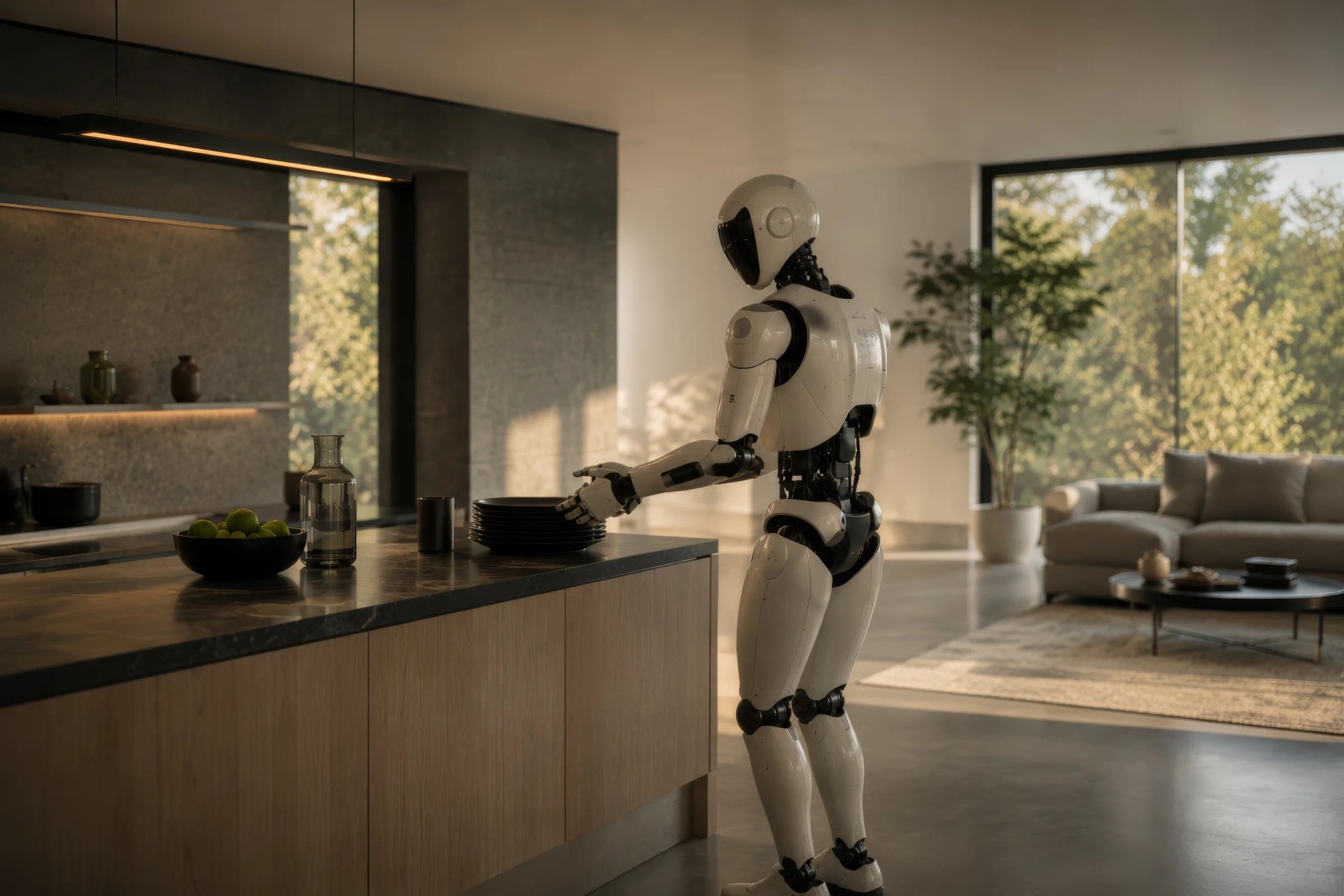
Artificial intelligence is leaving screens behind and settling into the physical world. It manipulates, decides and acts accordingly in settings involving friction, movement and uncertainty. The new frontier is no longer in digital environments; it lives in objects.
This shift implies a qualitative change. Intelligent systems, “embodied” in humanoid robots, organise tasks, adapt to changing contexts and improve with accumulated experience. In warehouses, laboratories, industrial sectors and even the home, they are taking on increasingly complex functions that require coordination, precision and the ability to react.
In this arena, artificial intelligence stops analysing data and starts producing evidence under real-world conditions, facing measurement errors, imperfect materials and unpredictable settings.
For companies, this opens up two fronts. On the one hand, efficiency: automating processes, cutting costs and boosting productivity. On the other, experience: introducing layers of interaction in which humans and machines converge and visibly collaborate.
Consumers’ response wavers between fascination and caution. The possibility of living alongside autonomous systems sparks curiosity, but also raises questions about control, reliability and limits. As a result, adoption is advancing in a fragmented way, at different speeds depending on context, sector and access.
Far from a futuristic scenario, this transformation is already under way. It is still partial and uneven, but enough to signal a change of cycle: when intelligence learns to operate in the tangible world, its impact stops being incremental and begins to redefine the rules of the game.
Cases
01 / 08New rules for living together
The arrival of robots in everyday life, however, does not present a shared scenario. Their rollout is uneven and prioritised in places where cost, infrastructure and investment make it viable. Not every household or workplace will experience this change at the same time or in the same way. Besides setting the pace of adoption, this difference makes the gap in everyday experience, increasingly mediated by technology, even more evident.
So while some people and companies delegate tasks and live alongside autonomous systems built into their daily lives, others make do with more limited versions or are left out of the new system altogether. Although, as in other transitions, what sets people apart today will eventually become democratised, this process brings new norms, expectations and less visible inequalities.
But their uptake does not depend on accessibility alone. These systems need to fit into existing dynamics without creating friction. Consumer acceptance of humanoid robots hinges on their ability to adapt to routines and habits, operating discreetly, naturally and without being intrusive.
On the other hand, as they gain autonomy, it becomes necessary to set clear frameworks for use covering safety, accountability, oversight and data protection. Likewise, if a growing share of economic value starts to be generated through automation, it will be essential to rethink how redistribution mechanisms are sustained in an economy where human work is no longer the central axis.
Zorraquino spotlights
- 01
Humanoid robots mark AI’s definitive move into the physical world, turning intelligence into an active presence in physical, everyday settings.
- 02
Robots are moving from taking orders to interacting and making decisions in real time, redefining the human-machine relationship, which shifts from occasional use to coexistence.
- 03
Integration won’t be immediate and will depend largely on these robots’ ability to adapt to human routines without creating friction or being intrusive.
- 04
Humanoid robots have gone from helping to replacing people in tasks both at home and at work, taking over spaces that until now defined human labour.
- 05
The more autonomous humanoid robots become, the more urgent it is to set clear frameworks for ethics, safety and accountability to guide their integration into spaces shared with people.
- 06
Tech companies play a decisive role, beyond their rollout, in defining how human-machine coexistence works in practice, balancing efficiency and experience.
Zorraquino playlist
- The RobotsKraftwerk · 1978
- ¿Hay alguien A.I.?Jorge Drexler · 2026
- La rebelión de los electrodomésticosAlaska Y Los Pegamoides · 1982
More on the trend
References
- @n.mas
- Japón quiere 10 millones de robots humanoides para 2040: cuidarán de los mayores y trabajarán en la industria
- El auge de los robots humanoides: un mercado que podría crecer al 50% anual hasta 2035
- Humanoid Robot Market Size, Share & Global Forecast 2026-2035
- La nueva frontera de la IA no está en internet, está en los objetos
- Amazon contempla cambiar a 600.000 empleados por robots en EEUU mientras evita hablar sobre sus planes en España
- El gran reto de la robótica humanoide y por qué todavía no han llegado a nuestras casas: “Si consiguen eso, habrán superado al camarero”
- Robots humanoides: qué pueden hacer, cuáles son sus límites y cómo cambiarán el trabajo
- Robots humanoides: cinco debates que no conviene retrasar
- Román Orús: “En unos años nos parecerá increíble el mundo como es hoy, tendremos robots humanoides en casa”
- Lo más llamativo del nuevo Eufy Omni S2 no es cómo limpia, es que este aspirador todoterreno es también un difusor de aromaterapia
- El extraño robot que quiere neutralizar al humanoide chino con un diseño radical
- Precisión del 100%: el robot humanoide que no falla en la Liga de baloncesto de Tokio gracias a la IA
- Figure demuestra la destreza de sus robots humanoides al realizar tareas del hogar
- Un robot pliega ropa de forma aparentemente autónoma, pero guarda un secreto en su interior
- UBTECH lanza UWORLD U1, el primer robot humanoide ultrabiónico de tamaño real producido en masa del mundo
- DECATHLON PONE A PRUEBA UN ROBOT FRENTE AL DESAFÍO DE LA MONTAÑA REAL
- La campa ñ a que creó un robot para demostrar que no lo necesitas
- LG avanza en la robótica para el hogar con CLOiD, que incorpora Inteligencia Artificial
- Gatsby
- Inside the company building America’s first mail-order servant robot
- El fenómeno viral de los robots mendigos pidiendo limosna en la calle: “No tengo dinero para recargar mi batería”
- what are musk, zuckerberg and bezos’ robot dogs doing at art basel miami?
- Vídeo. Corea del Sur abre en Seúl el Galaxy Robot Park con K-pop
- NEO Gets New Hands
Pages 331–357 of the report