Trend 03
Elitist impunity
Elitist impunity
Elite impunity consolidates an architecture of armoured privilege, where power operates outside any accountability.
Trend axes
- Oligarchic drift
- Selective justice
- Tech sovereignty
- Untouchable class
Some figures
8.2%
Average federal tax rate paid by the 400 wealthiest billionaire families in the United States, compared with the 13% paid by the average American.
239
Millions of dollars raised by the inaugural committee for Donald Trump’s second term in 2025, smashing every record to date.
34
Number of counts of falsifying business records of which Donald Trump has been convicted; thanks to an unconditional discharge, he was able to be re-elected president.
1,350
Number of State Department employees Donald Trump will lay off to focus on what he has called “diplomatic priorities”.
Power that answers to no one
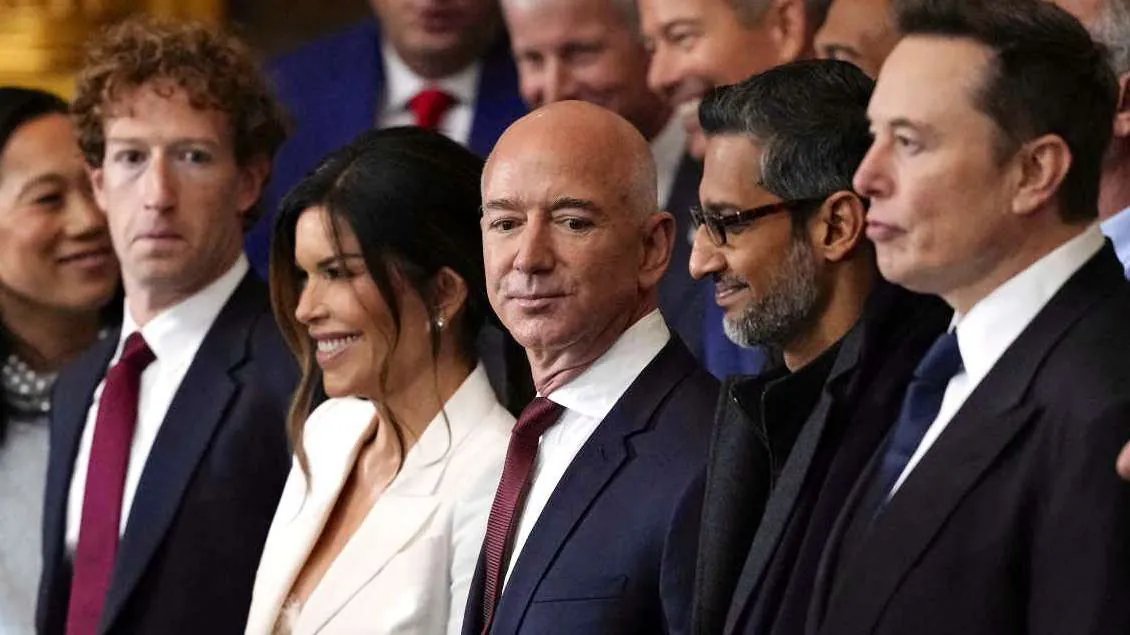
In the architecture of contemporary power, elite impunity is no longer an anomaly but an operating principle. In the United States this phenomenon is especially stark: great fortunes, political office-holders and influential figures from the private sector, from tech magnates to senior officials, operate behind armour that lets them sidestep the controls that apply to the rest of society. Sanctions, when they come, are symbolic.
This dynamic is not limited to the accumulation of wealth; it extends to strategic control of key sectors. These elites’ power lies not only in money, but in their ability to influence legislation, shape public policy and mould narratives on a global scale. The link between corporate interests and government structures creates a closed circuit in which the decisions with the greatest social and geopolitical impact are taken without transparency.
In this context, impunity acts as a multiplier of privilege: those who hold power can act first and negotiate later, if at all. Rules are applied selectively, institutional oversight weakens and punishment is reserved, almost exclusively, for those without access to that architecture of protection. Big tech, arms corporations and investment funds concentrate an influence capable of redefining national priorities and upsetting international balances without being subject to effective control.
The global order is thus being redefined not by the strength of the law, but by the ability of certain actors to place themselves above it. The erosion of accountability feeds a growing gap between citizens and elites, reinforcing the perception that there are two systems: one in which power is subject to the law, and another, reserved for a minority, in which the law is just another tool for holding on to that power.
Cases
01 / 05More on the trend
References
- Las protestas en Venecia que forzaron al multimillonario Jeff Bezos a cambiar el lugar de su fastuosa boda
- Fin de fiesta de Jeff Bezos y Lauren Sánchez en Venecia: baile de máscaras y manifestación contra la boda
- J.D Vance, vicepresidente de EEUU, exige que suban el caudal de un río para hacer una excursión con su familia
- La obscena impunidad de Juan Carlos I
- Reina la impunidad de la Corona en España: Juan Carlos I vuelve a Sanxenxo
- La fiscal que procesó a Jeffrey Epstein, despedida en plena ofensiva de Trump para acallar a los MAGA que le piden cuentas: “Son estúpidos”
- Trump intenta esquivar los daños del caso Epstein, pero solo está empeorando las cosas para su Gobierno
- Zuckerberg’s new Meta AI app gets personal in a very creepy way
- El negocio de ser (o parecer) o malo: "Vamos hacia una impunidad absoluta, ser malote hoy tiene recompensa, es cool"
- Oligarchy in the open: What happens now as the U.S. is forced to confront its plutocracy problem?
- What Elon Musk’s Salute Was All About
- ¿Cuánto afectan los aranceles de Trump a tu país?
- Empresas y otros donantes dieron a Trump 239 millones de dólares para los fastos de su investidura
- EE.UU. despedirá a más de 1.350 empleados del Departamento de Estado por decisión de Trump
Pages 26–35 of the report